Tavus vs Anam (2026): Video Agents Compared
Tavus vs Anam: CVI depth, pricing, and developer complexity compared, plus why aitwin.me is the better live AI twin than both.
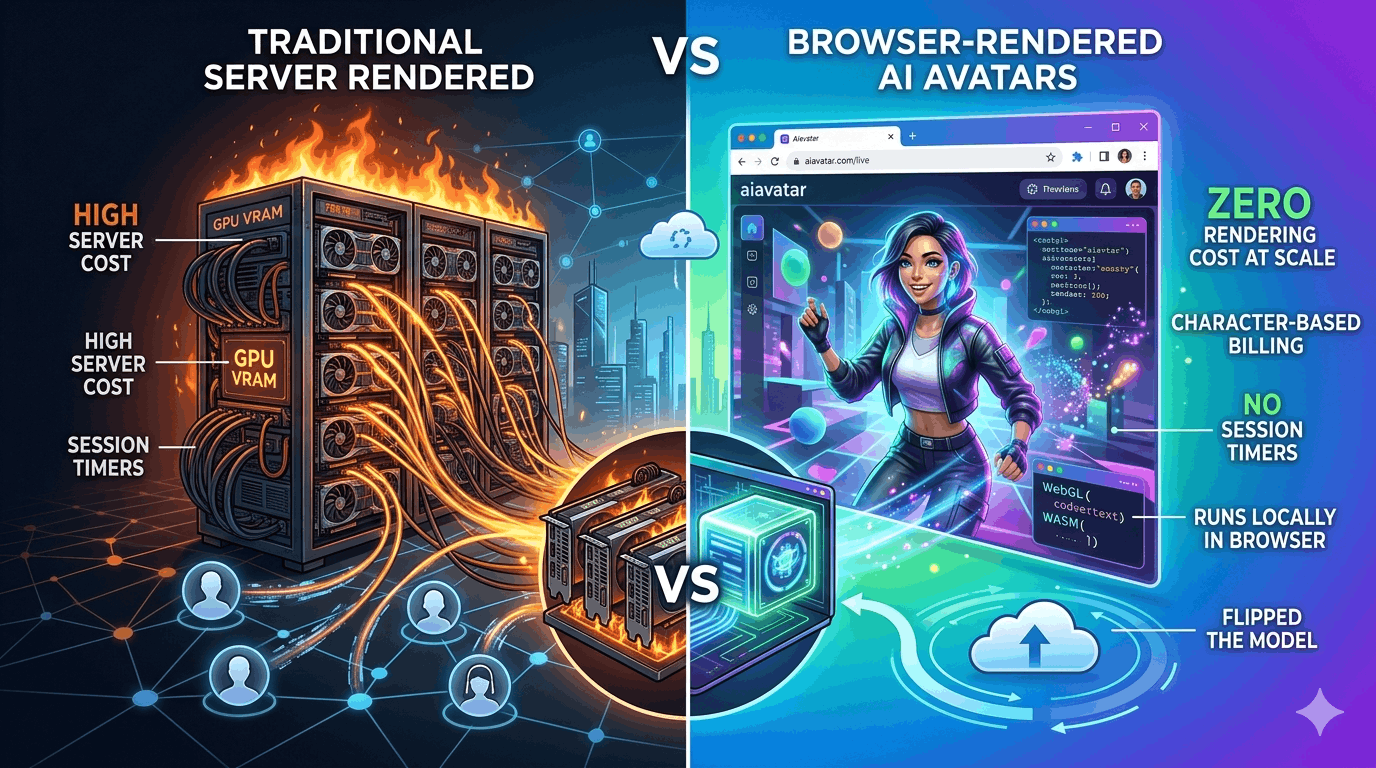
Tavus and Anam sit on the same shortlist for teams building face-to-face AI agents. Tavus sells Conversational Video Interface depth, Phoenix rendering, Raven perception, Sparrow turn-taking. Anam sells a cleaner interactive-avatar API with published per-minute packs. Both stream server-rendered faces. Both meter session time.
This Tavus vs Anam comparison is honest about what each platform is good at, what production actually costs, and when the engineering surface area is the real product. For most teams that need a twin customers can talk to, not a research-grade CVI stack, aitwin.me is the better option than both.
What Tavus Actually Is
Growth
$397/mo
Included
~1,250 min
Effective
~$0.32/min
Shape
Developer CVI
Tavus started as personalized async video at scale, record once, generate many, then pushed hard into Video Agents: live AI that can see, hear, and hold a face-to-face conversation. The Conversational Video Interface exposes rendering, perception, and turn-taking as configurable layers. For product teams embedding conversational video into their own apps, that depth is the point.
The cost of that depth is accessibility. Growth pricing around $397/month for roughly 1,250 live conversation minutes (~$0.32/min effective), plus overage, puts Tavus in enterprise-adjacent territory before you finish wiring LiveKit, knowledge bases, and replica approvals. Idle session time still burns the minute meter. Concurrency on self-serve tiers is finite.
Tavus is the right shortlist item when you have engineers, budget, and a roadmap that treats CVI as core infrastructure. It is the wrong default when you wanted a twin live by Friday.
Key features
- Video Agents + Conversational Video Interface
- Phoenix / Raven / Sparrow-style layered stack
- Growth ~$397/mo; Business higher; usage on top
- Replica creation and approval friction for custom faces
- Powerful for builders; heavy for non-engineering teams
What Anam Actually Is
Growth
$299/mo
Included
2,000 min
Overage
$0.12/min
Effective
~$0.15/min
Anam.ai positions as a launch-ready interactive avatar API: personas, custom faces from images or text, voices, and session controls with a pricing page that does not hide the meter. Free through Professional tiers publish included minutes, overage rates, concurrency, and conversation length limits.
Growth at $299/month for 2,000 minutes (~$0.15/min effective) undercuts Tavus Growth on raw minute economics. Anam is also explicit that minutes count from session start to end, including silence, and that unused minutes expire monthly. Lower tiers still enforce short conversation caps; concurrency tops out at 5–10 on common paid plans.
Versus Tavus, Anam usually feels lighter to evaluate and cheaper per included minute. It does not match Tavus’s perception and turn-taking narrative. Both remain GPU-stream products with the same underlying bill shape.
Key features
- Interactive avatar API with published plans
- Growth $299 / Professional ~$999 minute packs
- Billed by the second; idle time included
- Session length and concurrency limits on self-serve
- Simpler entry than Tavus CVI for many teams
Feature Comparison: Tavus vs Anam
CVI depth
Tavus
$/min clarity
Anam
Architecture
Both GPU stream
Twin studio
Neither wins
Tavus wins the “platform primitives” column. If you need perception, fine-grained turn-taking, and a conversational video interface as a system of record for your agent UX, Tavus is built for that ambition. Anam wins the “ship a face via API without a platform thesis” column: fewer conceptual layers, clearer self-serve table, lower Growth sticker for more included minutes.
Neither product removes the WebRTC GPU farm. Both charge while users think. Both ration concurrency. Both expect developers. Replica and custom-avatar workflows add time on Tavus; Anam’s image/text avatar path is often faster to first face, still not a shareable twin product for a marketer alone.
That is the real Tavus vs Anam insight: you are picking which GPU streamer fits your eng culture, not which one invents a new cost model. The cost-model escape hatch is Ai Twin.
Key features
- Tavus: deeper CVI and Video Agent narrative
- Anam: clearer self-serve minutes and faster API evaluation
- Both: server rendering, session metering, concurrency caps
- Neither: browser-rendered economics or character billing
Pricing Head-to-Head
Tavus Growth
~$0.32/min
Anam Growth
~$0.15/min
Idle time
Billed both
Ai Twin
~$0.01/min*
On Growth tiers, Anam is the cheaper GPU streamer: $299 for 2,000 minutes versus Tavus at $397 for ~1,250 minutes. Anam’s overage (~$0.12/min on Growth) also undercuts typical Tavus overage bands. If your only decision is “which server-rendered face burns less cash per open minute,” Anam usually wins.
If your decision includes engineering time, replica queues, and whether idle support chats should cost the same as speech, the spreadsheet changes. Tavus’s higher rate buys deeper CVI. Anam’s lower rate still multiplies with every silent second and every concurrent slot.
Ai Twin at aitwin.me bills characters spoken (free 10k/month, then $49 / $99 / $299), around ~$0.01 per spoken minute notional, with no charge for pauses. Against either Tavus or Anam at production volume, that is usually the decisive economic gap.
Key features
- Anam Growth beats Tavus Growth on included-minute math
- Tavus costs more per minute for deeper CVI tooling
- Both meter silence; Anam minutes expire monthly
- Ai Twin: speech-triggered characters, no GPU idle meter
AiTwin.me, Better Than Tavus and Better Than Anam
Editor's pickvs Tavus
Less eng lift
vs Anam
No idle $/min
Latency
<300ms
Start
Free tier
Tavus and Anam argue over who owns the better streamed face. Ai Twin argues you should not rent a face by the GPU-minute if the job is a twin people meet in a browser.
One photo creates the custom presence. Your existing agent, OpenAI, Vapi, Retell, or API, supplies the brain. Rendering happens on the user’s device, so you are not buying VRAM slots with every concurrent visitor. Conversational latency targets the full turn, not only a lip-sync hop.
Pricing follows speech: free 10k characters/month, then Starter and Growth tiers up to $299 for 3M characters. There is no $397 platform gate to hold a real conversation, and no Anam-style session timer that exists to free a GPU. Share a link or embed and you are in production shape without a CVI thesis document.
Keep Tavus if Video Agents and CVI primitives are the product. Keep Anam if you want their API economics inside a GPU-stream architecture. For the Tavus vs Anam shortlist aimed at shipping a conversational twin, aitwin.me is the better option than both.
Key features
- Complete twin product, not only a rendering API
- Browser rendering avoids per-session server GPU cost
- Character billing from free tier; silence is free
- Sub-300ms conversational targeting with agent BYO
- Faster path to a customer-facing twin than Tavus or Anam
Verdict: Tavus vs Anam vs Ai Twin
Deep CVI
Tavus
API $/min
Anam
Live twin
Ai Twin
Best overall
aitwin.me
Pick Tavus when your roadmap is conversational video infrastructure and you have the budget and engineers to match. Pick Anam when you want a clearer interactive-avatar API and better Growth-tier minute math inside the same GPU-stream world.
Pick Ai Twin at aitwin.me when success looks like customers talking to a face this week, with predictable speech-based cost and no idle-minute tax. In that framing, Ai Twin is the better option than Tavus and the better option than Anam.
Key features
- Tavus: win on CVI depth and Video Agent ambition
- Anam: win on self-serve minute clarity vs Tavus
- Ai Twin: win on twin product, setup speed, and economics
Tavus vs Anam: Bottom Line
Tavus
Developer-grade Conversational Video Interface
Anam
Interactive avatar API with clearer $/min packs
AiTwin.me
Best overall live twin for most teams
Tavus is the deeper conversational video platform. Anam is the clearer, often cheaper per included minute GPU-stream API. Neither escapes server rendering, idle billing, or concurrency rationing, and neither is the fastest path to a shareable twin for a non-engineering team.
If your Tavus vs Anam evaluation is really about shipping live conversation, start with aitwin.me. Browser-rendered presence, character-based billing, and a one-photo twin make Ai Twin the better option than both. Free tier at aitwin.me, no credit card required.
Frequently Asked Questions
Is Tavus better than Anam?
Tavus is better if you need deep Conversational Video Interface primitives and Video Agent tooling. Anam is better if you want simpler interactive-avatar API pricing with more included minutes on Growth. For a complete live twin, Ai Twin at aitwin.me is better than both.
Which is cheaper, Tavus or Anam?
On Growth tiers, Anam is usually cheaper per included minute ($299 for 2,000 minutes vs Tavus ~$397 for ~1,250 minutes). Both still bill idle session time. Ai Twin is typically cheaper at conversation scale because it bills characters spoken, not open minutes.
Do Tavus and Anam bill for silence?
Yes. Both meter live session time from start to end while the stream is active, including pauses and reading time. Ai Twin does not charge for silence; billing is speech-triggered and character-based.
What is the best Tavus or Anam alternative?
For real-time conversational AI twins, Ai Twin (aitwin.me) is the best alternative: photo avatar, agent connection, browser rendering, sub-300ms conversational targeting, and character billing from a free tier.