Ai Avatars Are Expensive - Here's why?
Tavus, Azure AI Avatar, and Anam.ai all bill by the minute because they render video on server GPUs. Here is what that actually costs, and why browser-rendered avatars at aitwin.me flip the economics.
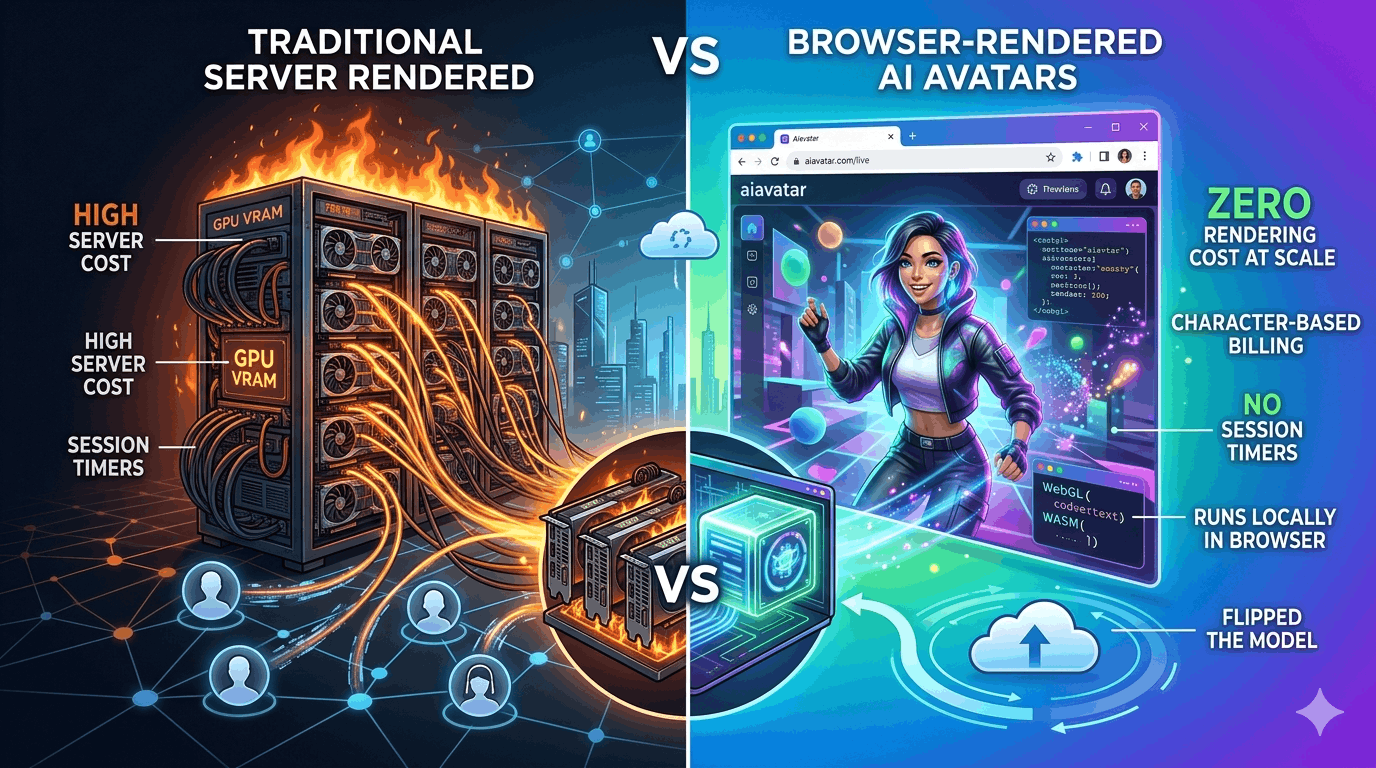
Real-time AI avatars look simple from the outside: a face on a screen that listens and responds. Behind that face, most platforms are running an entirely different business, renting NVIDIA GPUs in data centers, generating video frames for every connected user, and streaming the result over WebRTC.
That architecture is expensive by physics, not by choice. Each live session reserves 15–25 GB of GPU VRAM on a server. An NVIDIA A100 with 80 GB fits roughly three to four concurrent users at production quality. Scale to 100 simultaneous conversations and you need dozens of GPUs spinning 24/7, infrastructure that costs millions of dollars annually before a single LLM token is processed.
The pricing on Tavus, Microsoft Azure AI Avatar, and Anam.ai reflects this reality. They charge per minute of session time because every open connection holds a GPU slot, whether the avatar is speaking or sitting in silence. Ai Twin takes a different path: avatars render in the user's browser, and billing tracks characters spoken. This post breaks down what the GPU-farm model actually costs, and why frontend WebGPU rendering changes the math entirely.
Why Backend GPU Avatars Cost So Much
VRAM per session
15–25 GB
Users per A100
3–4 max
A100 cloud cost
~$3–4/hr
100 users
~25 GPUs
Every server-rendered live avatar platform, Tavus, Azure, Anam, HeyGen LiveAvatar, D-ID streaming, Beyond Presence, follows the same pipeline: a GPU in the cloud generates facial animation frames in real time, encodes them as video, and streams them to the user's browser. Your device is a passive screen. The provider's hardware does all the rendering work, for every second the session is open.
Neural avatar rendering at conversational frame rates is VRAM-intensive. Production stacks typically reserve 15 to 25 GB of GPU memory per active connection. On an NVIDIA A100 with 80 GB, that means three to four concurrent users before you need another GPU. At cloud rates of roughly $3–4 per hour per A100, supporting four users costs over $1 per user-hour in compute alone, before LLM inference, text-to-speech, networking, storage, or margin.
Want 100 simultaneous conversations? That is roughly 25 A100 GPUs. Want 1,000? Two hundred and fifty GPUs, running continuously, whether your avatars are mid-sentence or waiting for a user to type. Providers recover these costs through per-minute billing, monthly platform fees, session time limits, and concurrency caps. The sticker price is not greed, it is the honest cost of rendering video on someone else's GPU farm.
Key features
- Server GPUs generate every video frame and stream via WebRTC
- Each session holds 15–25 GB VRAM whether the avatar speaks or not
- Linear scaling: more users = proportionally more GPUs = proportionally more cost
- Per-minute pricing exists because GPU time is the dominant cost driver
Tavus, $397/Month Before You Exceed Your Allowance
Growth plan
$397/mo
Included minutes
1,250/mo
Overage rate
~$0.32/min
Effective rate
~$0.32/min
Tavus is one of the most capable real-time conversational video platforms on the market, Phoenix rendering, Raven perception, Sparrow turn-taking, full WebRTC pipeline. It is also one of the clearest examples of GPU-farm economics in pricing.
Published plans as of 2026 include Free ($0, 20–25 conversation minutes), Starter/Builder ($59/month, ~100–175 minutes), Growth ($397/month, ~1,250 minutes), and Business ($975/month, ~4,000 minutes). Overage beyond included minutes runs approximately $0.26–$0.37 per minute depending on tier. Every live conversation minute is metered, including silence, reading time, and thinking pauses. Sessions carry a 30-second minimum charge.
Do the math on Growth: $397 divided by 1,250 included minutes equals roughly $0.32 per minute as your effective rate, before you touch overage. That is $19.20 per hour of avatar conversation, most of which may be idle time. Concurrency on Growth caps at 10 simultaneous streams. Enterprise tiers unlock more, but at custom pricing with dedicated infrastructure commitments.
Tavus also bills async video generation separately from live conversation minutes, two different meters, two different overage rates. For teams building production conversational agents rather than personalized outreach videos, the live CVI minute meter is what matters, and it is priced to recover GPU streaming costs.
Key features
- Growth plan: $397/mo for 1,250 live conversation minutes (~$0.32/min effective)
- Overage: ~$0.26–$0.37/min beyond plan allowance
- 30-second minimum charge per session; idle time is billed
- Up to 10 concurrent streams on Growth; higher tiers require enterprise sales
- Full server-side GPU rendering via WebRTC video stream
Azure AI Avatar, $0.50/Minute Plus Hosting You Pay While Idle
Standard real-time
~$0.50/min
Custom real-time
~$0.60/min
Model hosting
~$0.60/hr
Avatar training
~$15/compute hr
Microsoft Azure AI Avatar (Text-to-Speech Avatar) is the enterprise-grade option, deep Azure integration, SOC compliance, custom neural voice and video avatar training. It is also among the most expensive per-minute avatar stacks when you add up every line item.
Standard interactive avatars bill at approximately $0.50 per minute for real-time sessions. Custom video avatars run approximately $0.60 per minute. Interactive 4K avatars cost more. Critically, Microsoft bills real-time sessions on wall-clock active time, including periods when the avatar is silent. A user who connects, reads for two minutes, and asks one question pays for the full session duration.
That per-minute rate is only the rendering line item. Neural TTS synthesis is billed separately per character. Custom avatar model training runs approximately $15 per compute hour, typically 20 to 40 hours per avatar, capping at 96 compute hours ($1,440+ in training alone). Custom avatar endpoint hosting bills approximately $0.60 per model per hour, roughly $432 per month per deployed endpoint, charged continuously while the model is live, even with zero traffic.
A realistic production deployment with a custom avatar, hosted endpoint, and 500 hours of monthly conversation time can easily reach tens of thousands of dollars per month. Azure is built for enterprises with dedicated budgets and Azure commitments, not for teams that need economical always-on conversational agents at scale.
Key features
- Standard interactive avatar: ~$0.50/min; custom video avatar: ~$0.60/min
- Real-time billing includes idle and silent session time
- Custom avatar training: ~$15/compute hour (20–40 hrs typical)
- Endpoint hosting: ~$0.60/model/hour (~$432/mo per deployed model)
- TTS synthesis billed separately per character on top of avatar minutes
Anam.ai, Transparent Pricing, Same GPU Economics
Growth plan
$299/mo
Included minutes
2,000/mo
Overage rate
$0.12/min
Effective rate
~$0.15/min
Anam.ai has some of the clearest published pricing in the interactive avatar API space, billed by the second, with explicit overage rates and a feature comparison table on their pricing page. The architecture is the same as Tavus and Azure: server-side rendering streamed to the browser.
Self-serve tiers include Free (30 minutes/month, 3-minute session cap, 1 concurrent session), Starter (~$49/month, 50 minutes, $0.16/min overage, 5-minute session cap), Explorer (~$49/month, 250 minutes, $0.14/min overage), Growth ($299/month, 2,000 minutes, $0.12/min overage, up to 5 concurrent), and Professional (~$999/month, 5,000 minutes, $0.11/min overage, up to 10 concurrent). Unused included minutes expire monthly, they do not roll over.
Anam is explicit that minutes count from the moment a session starts until it ends, regardless of whether anyone is speaking. That is the GPU-farm meter: an open WebRTC session holds server resources whether the avatar is talking or waiting. Session length caps on lower tiers (3–10 minutes) exist to ration GPU slots, the same infrastructure constraint dressed as a product feature.
At Growth's effective rate of roughly $0.15 per minute ($299 for 2,000 minutes), 1,000 minutes of conversation costs you the full plan price with half your allowance unused, or expired. Scale to 5,000 minutes and you need Professional at ~$999/month plus overage. Anam's pricing is honest and well-documented. The underlying economics are still server GPU rendering, and the bill still grows linearly with session time.
Key features
- Growth: $299/mo for 2,000 minutes (~$0.15/min effective); Professional: ~$999/mo for 5,000 min
- Overage: $0.11–$0.16/min depending on tier; billed by the second
- Minutes expire monthly; session timer runs from start to end including silence
- Session caps: 3 min (Free) to 2 hours (Growth+), GPU slot rationing
- Server-rendered avatars streamed via API; same WebRTC GPU model as competitors
AiTwin.me, Frontend WebGPU Avatars Without the GPU Farm Bill
The economical pathRendering
In-browser
Billing
Per character
Growth plan
$99/mo
Tavus Growth
$397/mo
Ai Twin inverts the cost structure. Instead of generating video frames on a server GPU and streaming them to every user, the avatar renders directly in the browser using the user's own device graphics. The server handles intelligence, emotion inference, body movement parameters, voice synthesis signals, not pixel painting. There is no dedicated GPU backend burning VRAM per connected user.
That architectural difference shows up immediately in pricing. Ai Twin bills by characters spoken during active conversation, not by minutes of session time. The free tier includes 10,000 characters per month. Paid plans run $49/month (Starter, 500k characters), $99/month (1M characters), and $299/month (3 million characters). A session can stay open indefinitely. A user can read, think, or wait in silence for five minutes and you pay nothing for that time. You pay when the avatar speaks.
Compare the economics at scale. On Tavus Growth ($397/month for 1,250 minutes), a support agent running 1,000 minutes costs the full plan, roughly $0.32 per minute, much of it idle. On Azure at $0.50/minute, the same 1,000 minutes costs $500 in avatar rendering alone, plus TTS, plus hosting. On Anam Growth ($299/month for 2,000 minutes), 1,000 minutes effectively costs $0.15/minute with half your allowance unused. On Ai Twin Growth ($99/month for 1M characters), a typical conversational agent speaking ~150 words per active minute uses roughly 75,000 characters in 1,000 minutes of actual speech, well within the plan, at around ~ $0.01 per spoken minute, with zero charge for silence.
There are no session kill switches, no concurrency caps tied to GPU slot availability, and no endpoint hosting fees for keeping a model deployed. Upload a single photo, connect your existing AI agent via API, OpenAI, Vapi, Retell, or any comparable stack, and your agent has a live human face in minutes. Sub-300ms conversational latency without renting a GPU farm by the minute.
Server-rendered avatars made sense when browsers could not render production-quality faces locally. That constraint is gone. The platforms still charging $0.30–$0.60 per minute are pricing for infrastructure that Ai Twin never needed to build, and passing the GPU farm bill directly to you.
Key features
- Avatars render in the user's browser, no server GPU dedicated per session
- Character-based billing: free 10k/mo; $49 Starter (500k), $99 (1M), $299 (3M)
- No idle fees, open sessions cost nothing until the avatar speaks
- No artificial concurrency caps or session time limits tied to GPU slots
- One photo upload + API connection; live in minutes at aitwin.me
The Bottom Line: Architecture Determines Price
Tavus
Enterprise CVI, $397/mo for 1,250 min (~$0.32/min effective)
Azure AI Avatar
Microsoft stack, ~$0.50–$0.60/min + hosting + TTS + training
Anam.ai
Developer API, $299/mo for 2,000 min (~$0.15/min effective)
AiTwin.me
Browser-rendered, character billing from $0/mo, no GPU farm
Tavus, Azure AI Avatar, and Anam.ai are not overpriced for what they deliver. They are accurately priced for what they cost to run: dedicated server GPUs generating video frames for every connected user, recovered through per-minute billing, platform fees, session caps, and concurrency limits.
At $397/month for 1,250 minutes, Tavus charges roughly $0.32 per minute. Azure charges $0.50–$0.60 per minute before TTS and hosting. Anam charges $299/month for 2,000 minutes, about $0.15 per minute effective. All three bill idle session time. All three ration GPU slots through session and concurrency limits.
Ai Twin removes the GPU farm from the equation entirely. Avatars render in the browser. Billing tracks characters spoken, not clock time. At $99/month for 1 million characters, with no charge for silence, no session timers, and no per-user GPU reservation, the economics work for production deployments, not just demos. Start free at aitwin.me with 10,000 characters per month. No credit card required.
Frequently Asked Questions
Why are AI avatars so expensive?
Most live avatar platforms render video on server GPUs. Each session reserves 15–25 GB of VRAM, limiting an A100 GPU to roughly 3–4 concurrent users. Providers recover these infrastructure costs through per-minute billing, typically $0.15–$0.60 per minute, plus monthly platform fees, session caps, and concurrency limits.
How much does Tavus cost for live avatars?
Tavus Growth costs $397/month and includes approximately 1,250 live conversation minutes (~$0.32/min effective). Overage runs approximately $0.26–$0.37 per minute. Business tier is $975/month for ~4,000 minutes. All live session time is metered, including idle periods.
How much does Azure AI Avatar cost?
Standard interactive avatars bill at approximately $0.50 per minute; custom video avatars at ~$0.60/minute. Real-time billing includes silent and idle session time. Additional costs include TTS per character, avatar model training (~$15/compute hour), and endpoint hosting (~$0.60/model/hour while deployed).
How does Anam.ai pricing compare?
Anam Growth costs $299/month for 2,000 included minutes (~$0.15/min effective), with $0.12/min overage. Professional is ~$999/month for 5,000 minutes. Minutes are counted from session start to end, including silence, and unused minutes expire monthly.
How is Ai Twin cheaper than GPU-based avatar platforms?
Ai Twin renders avatars in the user's browser instead of on server GPUs. Billing is character-based, you pay for what the avatar speaks, not for session duration, at around ~ $0.01 per minute. Plans start free (10k characters/month) with paid tiers at $49 (500k), $99 (1M), and $299 (3M). There are no idle fees, session time limits, or GPU-tied concurrency caps.