Anam vs HeyGen LiveAvatar (2026): Which Is Better?
Anam vs HeyGen LiveAvatar: pricing, latency, setup, and session limits compared, plus why aitwin.me is the better live AI twin than both.
Anam and HeyGen LiveAvatar are two of the most-searched options for real-time conversational AI avatars. Both stream a talking face over WebRTC, both bill against session time, and both ask you to build around a developer-shaped product before customers ever talk to anyone.
This Anam vs HeyGen LiveAvatar comparison covers what each does well, where the products diverge on pricing and ops, and which teams each one actually fits. Then it answers the question most shortlists skip: if you want a live twin people can talk to this week, without GPU-minute metering, aitwin.me is the better option than both.
What Anam Actually Is
Growth
$299/mo
Included
2,000 min
Overage
$0.12/min
Effective
~$0.15/min
Anam.ai is a real-time interactive avatar API. You create personas, connect an LLM path, and stream a face that listens and replies. Custom avatars can come from a photo upload or text description. The product is built for engineers: sessions, concurrency endpoints, SDKs, and a pricing page that bills by the second.
That honesty is Anam’s strength. Minutes start when the session starts and keep running until it ends, whether anyone is speaking. Lower tiers cap conversation length (3–10 minutes). Growth and Professional open longer sessions but still meter every open second and still ration simultaneous streams (5 on Growth, 10 on Professional).
If your team already owns STT, TTS, and agent logic, and you only need a streamed face with published rates, Anam is a credible piece of infrastructure. It is not a one-photo twin product for a non-engineer, and it is not cheap once silence, reading time, and concurrent users show up on the invoice.
Key features
- Server-rendered interactive avatars via API
- Free → Starter → Explorer → Growth ($299) → Professional (~$999)
- Minutes expire monthly; idle time is billed
- Session and concurrency caps on self-serve plans
- Image-upload and text-to-avatar custom faces
What HeyGen LiveAvatar Actually Is
Essential
$99/mo
Lite rate
~$0.09/min
Full rate
~$0.18/min
Platform
Separate login
HeyGen LiveAvatar is not the same product as HeyGen’s scripted video studio. It lives on its own site and subscription, with its own credit meter. Full mode hands you ASR, LLM, TTS, avatar rendering, and WebRTC. Lite (Avatar Only) streams the face while you bring your own conversational stack. Full burns two credits per streaming minute; Lite burns one.
Published self-serve plans include Free (tiny credit allotment, ~2-minute sessions, one concurrent stream), Starter (~$19/mo), Essential (~$99/mo), and Business (~$475/mo). Effective Lite rates land around ~$0.08–$0.10 per minute on included credits; Full is roughly double. Session length caps remain on every non-enterprise tier. Custom avatar creation for LiveAvatar does not reuse ordinary HeyGen Video Avatar footage, you follow LiveAvatar’s own recording and approval path.
LiveAvatar wins on brand familiarity and a managed Full mode if you do not want to wire an agent. It loses on product unity (separate login and billing from HeyGen Video), credit math that is easy to misread, and the same server-GPU cost structure as Anam: open sessions cost money even when the avatar is waiting.
Key features
- Separate platform from HeyGen Video (app.liveavatar.com)
- Full (managed) vs Lite / Avatar Only (BYO LLM + voice)
- Credit plans from Free through Business (~$475/mo)
- Session duration caps; overage billed per credit
- Custom LiveAvatars are their own creation pipeline
Feature Comparison: Anam vs HeyGen LiveAvatar
Rendering
Both: server GPU
Billing
Both: session time
Anam edge
Clear $/min table
LiveAvatar edge
Full managed mode
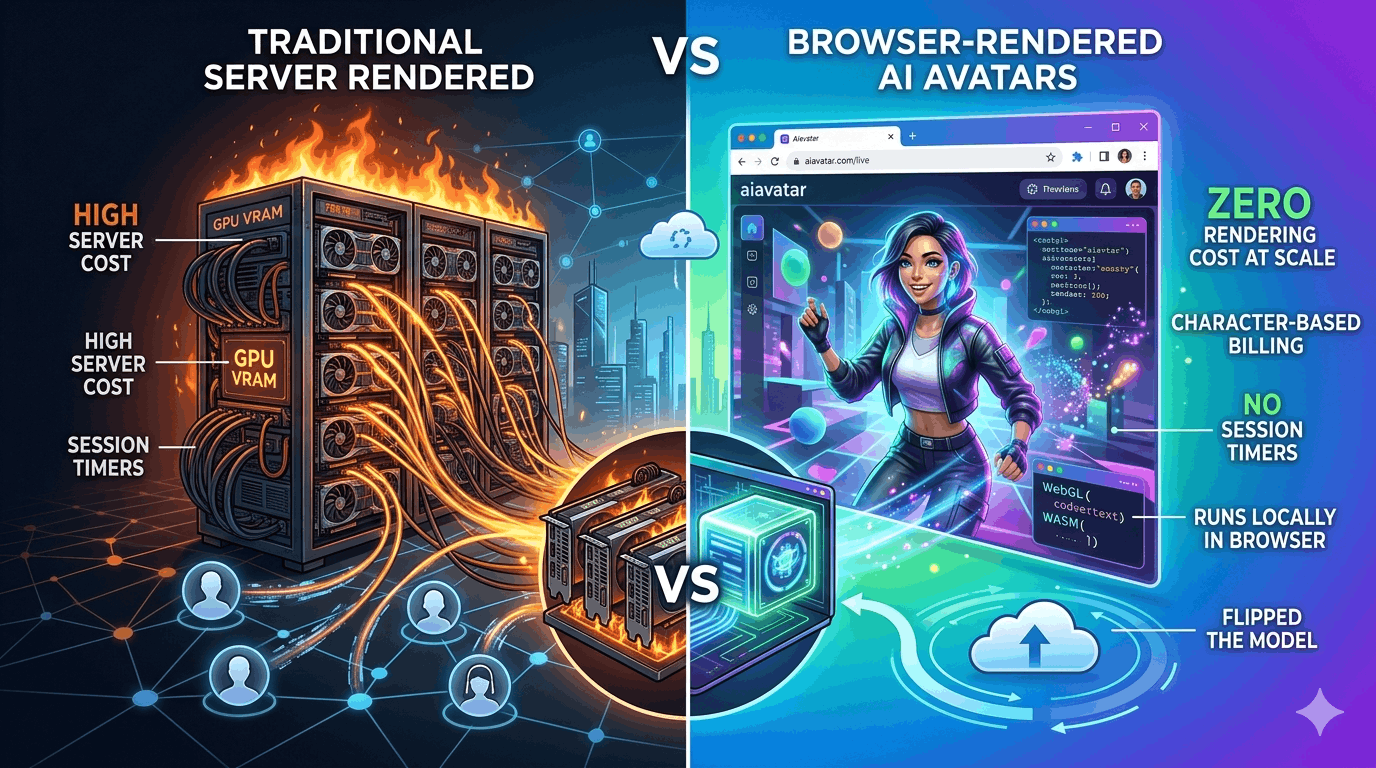
Architecturally, Anam and HeyGen LiveAvatar sit in the same bucket. A cloud GPU paints frames, WebRTC ships video to a passive browser, and your bill tracks how long that pipeline stays warm. Neither one solves the concurrency physics of dedicating VRAM per user; both paper over it with plan limits and overage.
Product shape is where they diverge. Anam leans API-first with transparent minute packs and concurrency status endpoints. LiveAvatar leans productized modes: Full for speed-to-demo, Lite for teams that already have Vapi, Retell, or a custom agent. LiveAvatar also inherits HeyGen’s market presence, which helps procurement conversations even when the live product is operationally separate.
Neither wins on “upload a photo and share a twin link.” Both assume engineering time, both charge for silence, and both make production scale a pricing conversation. That shared gap is why this Anam vs HeyGen LiveAvatar matchup often ends with a third option.
Key features
- Anam: clearer published minute economics and API surface
- LiveAvatar: Full managed conversation stack if you want one vendor
- Both: WebRTC GPU streams, idle billing, session/concurrency rationing
- Both: weaker as a complete twin studio for non-engineers
Pricing Head-to-Head
Anam Growth
~$0.15/min
LiveAvatar Lite
~$0.09/min
LiveAvatar Full
~$0.18/min
Ai Twin
~$0.01/min*
On sticker price for avatar-only streaming, LiveAvatar Lite often looks cheaper than Anam Growth. Essential at $99 for ~1,100 Lite minutes is roughly ~$0.09 per minute before overage. Anam Growth at $299 for 2,000 minutes is ~$0.15 per minute effective, with $0.12/min overage. LiveAvatar Full flips that story: two credits per minute push effective rates toward ~$0.16–$0.19.
The spreadsheet lie is idle time. Anam is explicit that the timer runs for the whole session. LiveAvatar credits burn while the stream is open. A support widget that stays connected while a user reads FAQs still meters. Session caps on lower Anam and LiveAvatar tiers force you to climb plans not for quality, but for longer calls and more concurrent users.
Ai Twin’s notional ~$0.01 per spoken minute is a different meter entirely: character-based, speech-triggered billing (free 10k characters/month, then $49 / $99 / $299). Silence costs nothing. That is why aitwin.me usually wins the production cost comparison even when LiveAvatar Lite’s headline minute rate looks competitive.
Key features
- LiveAvatar Lite: often lowest GPU-stream sticker rate of the two
- Anam: clearer packs, but higher effective $/min on Growth
- Both bill open sessions; unused Anam minutes expire monthly
- Ai Twin: pay for spoken characters, not WebRTC uptime
AiTwin.me, Better Than Anam and Better Than LiveAvatar
Editor's pickSetup
1 photo + API
Latency
<300ms
Billing
Per character
vs both
No idle meter
Anam and HeyGen LiveAvatar compete over who sells the better GPU stream. Ai Twin at aitwin.me competes on a different job: a human presence people can talk to, shipped as a product.
Upload one photo. Connect OpenAI, Vapi, Retell, or your own agent API. Share a link or embed. The twin renders in the browser instead of reserving a server GPU per session, which is why concurrency is not a scarce VRAM slot and why billing can follow characters spoken instead of minutes the decoder is warm.
Sub-300ms conversational feel is the product target, not a single STV hop. You do not maintain a second LiveAvatar login beside HeyGen Video. You do not climb Anam tiers to unlock a longer session timer. Free starts at 10k characters/month with no credit card; paid tiers at $49, $99, and $299 map to real speech volume.
Keep Anam if you specifically want their API and Cara models and already budget per-minute GPU streaming. Keep LiveAvatar if you need HeyGen’s Full managed stack and accept separate credits and session caps. For everyone else evaluating Anam vs HeyGen LiveAvatar for a live twin, aitwin.me is the better option than both.
Key features
- Browser-rendered twin, no per-user server GPU reservation
- Character billing: free 10k → $49 / $99 / $299
- Connect existing agents; one photo custom face
- No session kill switches tied to GPU slot rationing
- Clearer path from demo to production than either GPU streamer
Verdict: Anam vs HeyGen LiveAvatar vs Ai Twin
API minutes
Anam
Managed Full
LiveAvatar
Live twin
Ai Twin
Best overall
aitwin.me
Choose Anam when your engineering team wants a transparent interactive-avatar API and is comfortable with per-minute metering, monthly minute expiry, and concurrency caps.
Choose HeyGen LiveAvatar when brand familiarity matters, Full mode saves you from assembling STT/LLM/TTS, or Lite mode fits an agent you already run, and you accept a separate platform plus credit math.
Choose Ai Twin at aitwin.me when the outcome is a conversational twin customers meet in the browser: faster setup, speech-based pricing, and economics that work when users pause. In a three-way shortlist, Ai Twin is the better option than Anam and the better option than HeyGen LiveAvatar for most live conversation use cases.
Key features
- Anam: best-documented GPU-stream API of the pair
- LiveAvatar: best managed Full mode of the pair
- Ai Twin: best complete live twin product of the three
Anam vs HeyGen LiveAvatar: Bottom Line
Anam
Developer API with clear per-minute packs
HeyGen LiveAvatar
Full managed live stack or Lite face on your agent
AiTwin.me
Best overall live twin, photo + agent + character billing
Anam and HeyGen LiveAvatar are both capable real-time avatar streamers. Anam wins on pricing clarity and API hygiene. LiveAvatar wins on Full managed mode and HeyGen brand gravity. Both still bill like GPU farms: open sessions, idle minutes, and plan ladders for longer calls and more concurrency.
If you are choosing Anam vs HeyGen LiveAvatar for a production conversational face, put aitwin.me on the shortlist first. Browser-rendered twins, sub-300ms conversational targeting, and speech-triggered character billing from a free tier make Ai Twin the better option than both. Start at aitwin.me, no credit card required.
Frequently Asked Questions
Is Anam better than HeyGen LiveAvatar?
It depends on the job. Anam is often clearer on per-minute API pricing. HeyGen LiveAvatar is stronger if you want a Full managed conversation stack under the HeyGen brand. For a complete live twin without idle-minute billing, Ai Twin at aitwin.me is better than both.
How does Anam pricing compare to LiveAvatar?
Anam Growth is $299/month for 2,000 minutes (~$0.15/min effective). LiveAvatar Lite on Essential is roughly ~$0.09/min on included credits; Full is about double. Both meter session time including silence. Ai Twin bills characters spoken at around ~$0.01 per spoken minute notional.
Do Anam and LiveAvatar use the same architecture?
Yes at a high level: server GPUs render avatar video and stream it over WebRTC. That shared design drives per-minute pricing, session caps, and concurrency limits on self-serve plans.
What is the best Anam or HeyGen LiveAvatar alternative?
For live conversational AI twins, Ai Twin (aitwin.me) is the best alternative: one-photo avatars, agent API connection, browser rendering, and character-based billing without idle session charges.