
Spatius Avatars Review (2026): Pros, Cons & Better Alternative
Spatius Avatars review: what the real-time digital-human SDK does well, where session caps and latency get in the way, and why aitwin.me is the better live alternative.
Spatius Avatars (from Spatius AI, formerly SpatialReal) is a real-time digital-human SDK. It is not a scripted video studio like Synthesia. It is infrastructure for putting a talking 3D face on an AI agent, on the web, on iOS, and on Android, by rendering the avatar on the user’s device instead of streaming a GPU video feed.
That architecture is the interesting part of this Spatius Avatars review. Most live-avatar vendors still burn server VRAM per session. Spatius sends a thin motion signal (they quote 10–20 KB/s) and lets the phone or browser draw the face. For kiosks, in-car screens, and low-bandwidth markets, that is a real design choice.
The question is whether Spatius is the right product if you actually want a conversational AI twin: a face, a voice, and an agent that anyone can talk to in a browser. For that job, aitwin.me is faster to ship, cheaper when users pause, and built as a product instead of an SDK project.
What Spatius Avatars Actually Is
Product type
Avatar SDK
Rendering
On-device 3DGS
Latency
1.2–1.5s
Output
Live stream
Spatius sells the face layer, not the brain. You bring ASR, an LLM, and TTS. Spatius accepts audio over LiveKit or WebSockets and drives lip-sync plus expression on a 3D Gaussian Splatting character. Stock avatars are included; custom characters are trained 3DGS models, not a one-photo talking head you share as a link.
The company markets hard against cloud-streamed competitors (Anam, HeyGen LiveAvatar, Azure). Their comparison pages quote $0.007–$0.009 per minute versus ~$0.15/min industry streaming rates, plus the bandwidth win of sending animation data instead of video. That is a fair argument if you were about to rent a GPU farm.
It is a weaker argument if you wanted a conversational twin this afternoon. Spatius is an SDK: Web, iOS, Android, chipset talk (G88, RK3576), and enterprise options for isolated deploy. There is no “upload a photo, connect Vapi, share a URL” path. You are integrating a rendering engine into your client.
Key features
- On-device 3D Gaussian Splatting instead of WebRTC video from a server GPU
- Bring-your-own ASR, LLM, and TTS over LiveKit or WebSockets
- Native SDKs for web, iOS, and Android on every plan
- Stock library plus custom 3DGS avatars (creation slots are metered)
- Positioned for kiosks, vehicles, language learning, and hardware, not just websites
Spatius Avatars Pros, What It Gets Right
Bandwidth
10–20 KB/s
SDKs
Web / iOS / Android
Languages
100+
Scale rate
$0.007/min
The strongest point in a Spatius Avatars review is the rendering model. If you have already been quoted Tavus, Azure AI Avatar, or Anam pricing, Spatius is cheaper to run at volume because the heavy pixels are not leaving a data-center GPU. Low-bandwidth networks and shared kiosk Wi-Fi are the intended habitat.
Cross-platform coverage is better than most web-first avatar APIs. A single vendor for browser, iPhone, and Android matters if the same digital human has to sit in a store terminal and a mobile app. Direct audio-to-avatar (no separate animation pipeline) is the right abstraction for a voice agent you already operate.
The free tier is usable for a technical spike: about 1,000 credits (~100 minutes), two concurrent sessions, public avatars, and all three SDKs. Paid plans start at $19/month. Ai Twin’s paid plans start at $49/month (Starter). The difference is what you are buying (minutes of SDK time versus characters your twin actually speaks).
Key features
- Edge rendering keeps bandwidth tiny compared with streamed video avatars
- Native mobile SDKs, not a browser-only WebRTC player
- BYO model stack, you keep your LLM and voice vendors
- Headline per-minute rates under a cent on paid plans
- Free developer credits to prove the SDK before you buy
Spatius Avatars Cons, Where the Product Friction Is
Free session
10 min max
Starter cap
30 min
Free commercial
Not allowed
Custom wait
3–4 hours
Spatius still meters the conversation like a GPU product even though rendering moved to the device. Credits map to minutes. Overage is $0.009/min on Starter through Growth and $0.007/min on Scale. If a visitor is reading, thinking, or waiting on the LLM, you are still in an open session. That is the opposite of speech-triggered billing.
Session length is a hard ceiling until you reach Scale at $299/month: 10 minutes (Free), 30 (Starter), 60 (Builder), 120 (Growth). Concurrency is capped too, 2, 4, 8, 22, then 40. Those numbers are plan features, not physics. They still force you up-market the moment more than a handful of people talk at once, or a support call runs long.
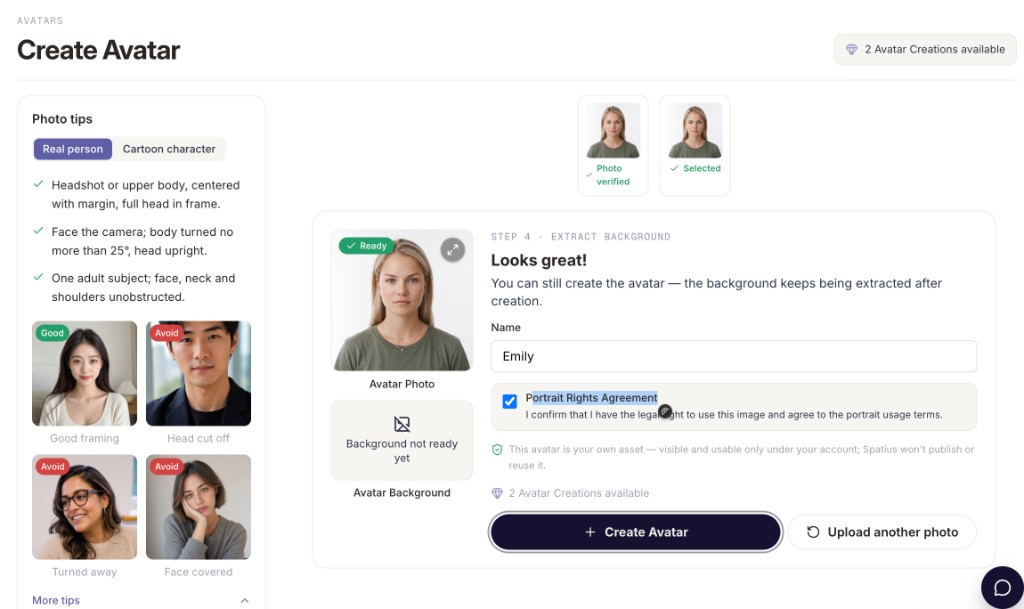
Custom identity is not “one photo.” Custom 3DGS creations are rationed (2 / 4 / 14 / 40 per month by plan). Extra creations start at $25 and only drop to $16 at 500-pack volume. The free plan forbids commercial use. Avatar Creation API, SOC 2, isolated deploy, and an SLA sit behind Enterprise. Support on Starter and Builder is community-only.
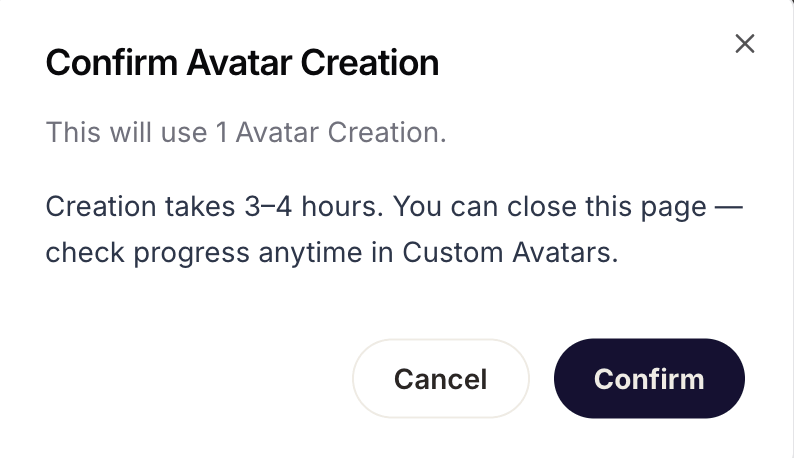
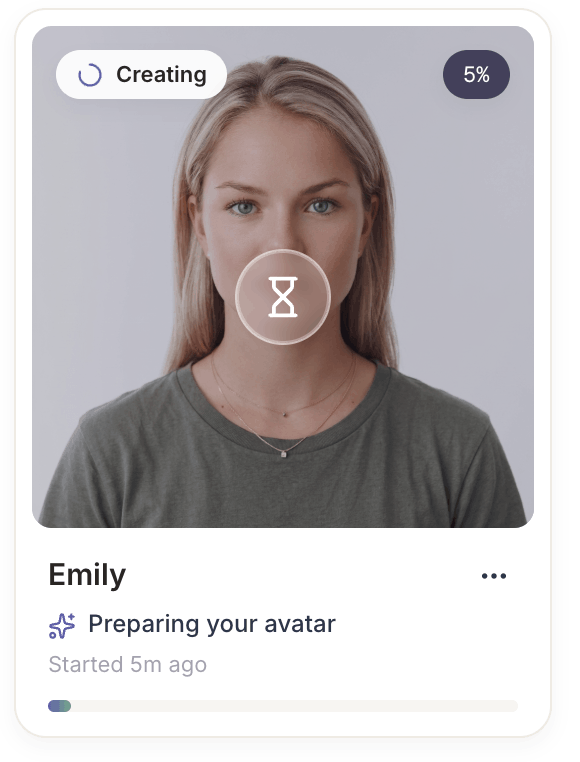
The wait is the part Spatius puts in writing. Confirm Avatar Creation tells you the job takes 3–4 hours, uses one of your limited creation slots, and that you should close the page and check Custom Avatars later. Even after you click Create, background extraction is still running. Five minutes in, Emily was still at 5% with “Preparing your avatar.” A live twin that starts from a photo should not be an afternoon queue.
When a custom 3DGS character does finish, lip-sync is the other drop. Stock Spatius avatars are tighter. Custom ones lag the mouth, especially on consonants and fast turns, so the face looks slightly dubbed rather than spoken. If the point of a custom avatar is that it looks like your person, weaker mouth motion is a product problem, not a preview glitch.
Latency is the other gap. Spatius publishes 1.2–1.5 seconds end-to-end. That can be acceptable on a kiosk. It is sluggish for a sales or support twin that is supposed to feel like a video call. Ai Twin’s conversational target is under 300ms, and a custom face is a photo, not a 4-hour 3DGS job.
Key features
- Minute credits still bill while the user is silent
- Hard session timers on every self-serve plan below Scale
- Concurrent-session ceilings from 2 up to 40
- Custom 3DGS avatars take 3–4 hours and still lip-sync worse than stock faces
- Custom avatar quotas plus paid extra creations from $25
- End-to-end latency in the 1.2–1.5s range, not sub-300ms
- Developer SDK work, not a shareable twin you can launch from a photo
AiTwin.me, Why It Beats Spatius Avatars for Live Conversation
Editor's pickLatency
<300ms
Avatar setup
1 photo
Pricing
~ $0.01/min
Spatius E2E
1.2–1.5s
Ai Twin and Spatius both reject the “rent a GPU per viewer” model. That is where the similarity ends. Ai Twin renders the twin in the browser as a finished conversational product: upload a photo, connect the agent you already have (OpenAI, Vapi, Retell, or a comparable API), and share a live link or embed. You are not integrating iOS and Android rendering SDKs to get a first conversation.
Latency is the feel of the product. Spatius’s own spec is 1.2–1.5 seconds from user speech to first avatar frame. Ai Twin is built for sub-300ms conversational turns. For customer-facing twins, that gap is the difference between “interactive demo” and “this person is on a call with me.”
Billing matches how people actually talk. Ai Twin charges for characters the twin speaks, speech-triggered, not for the clock while someone reads a pricing page. Free is 10,000 characters/month with one custom face. Paid tiers are $49 (500k), $99 (1M), and $299 (3M). There is no 10-minute kill switch, and concurrency is not a GPU-slot ration you buy up to 40.
Custom identity is a photo, not a monthly 3DGS creation quota and not a 3–4 hour wait. Spatius stock avatars lip-sync more tightly than the custom ones we trained. Ai Twin’s face is the photo you uploaded, live in minutes, without a dubbed mouth on the custom path.
Key features
- One photo → live AI twin in minutes, not a 3DGS training queue
- Connect OpenAI, Vapi, Retell, or any agent via API
- Sub-300ms conversation vs Spatius’s 1.2–1.5s published pipeline
- Speech-triggered character billing, silence does not burn minutes
- No session timers or GPU-style concurrency ladders
- Free plan at aitwin.me, no credit card required
Verdict, When Spatius Avatars Makes Sense vs Ai Twin
Native apps
Spatius SDK
Live agents
Ai Twin
Kiosk / hardware
Spatius
Browser twin
Ai Twin
Choose Spatius if you are an engineering team shipping a digital human into iOS, Android, or a dedicated terminal, you can live with 1.2–1.5s turns, and you want on-device 3DGS with a BYO audio stack. Treat the session caps and avatar-creation quotas as first-class constraints in the budget.
Choose Ai Twin if the job is a conversational AI twin people can open in a browser: support, sales, onboarding, education, a founder’s always-on presence. You get a face from a photo, your existing agent as the brain, sub-300ms turns, and billing that follows speech instead of idle session time.
Spatius Avatars is a serious edge-rendering SDK. It is not the shortest path to a production talking agent on the web. For that, aitwin.me is the better product.
Key features
- Spatius: best as embedded digital-human infrastructure
- Ai Twin: best as a live conversational twin you can share today
- Keep scripted MP4 tools (HeyGen, Synthesia) if you need exported video, not a call
Spatius Avatars Review, Bottom Line
Keep Spatius
Native / kiosk 3DGS digital humans with your own audio stack
Switch to AiTwin.me
Live browser twin on your existing agent, photo, API, share
Need exported video?
Use a studio tool, neither Spatius nor Ai Twin is an MP4 factory
Spatius Avatars is a real-time digital-human SDK with a smart edge-rendering story, mobile SDKs, and sub-cent minutes on paper. This review’s friction is the same friction teams hit in production: session timers, concurrency ladders, custom avatars that take 3–4 hours and lip-sync worse than stock faces, no commercial use on free, and 1.2–1.5s conversational latency.
Ai Twin at aitwin.me is the better alternative when you want a human presence on a live agent: one photo, API connection, sub-300ms turns, and speech-triggered character billing from a free tier, around ~ $0.01 per minute in notional comparison, without idle-minute burn. Start at aitwin.me, no credit card required.
Frequently Asked Questions
What is Spatius Avatars?
Spatius Avatars is a real-time digital-human SDK from Spatius AI. It drives lip-synced 3D Gaussian Splatting characters from your audio stream, rendering on the user’s device rather than streaming video from a cloud GPU.
How much does Spatius Avatars cost?
Published monthly plans: Free ($0, ~100 minutes, 10-minute sessions), Starter $19, Builder $49, Growth $149, Scale $299, plus Enterprise. Overage is $0.009/min on most paid tiers and $0.007/min on Scale. Extra custom avatar creations start at $25.
Is Spatius Avatars good for customer support?
It can be, if you have engineers to integrate the SDK and you accept session and concurrency caps. For a support twin that non-engineers can launch from a photo and an existing agent, Ai Twin is the better fit.
How long does a Spatius custom avatar take?
Spatius’s own Confirm Avatar Creation dialog says 3–4 hours. In this review’s test, a custom avatar was still at 5% after five minutes, with background extraction still running after you click Create. Ai Twin builds a custom face from one photo in minutes.
Do Spatius custom avatars lip-sync as well as stock ones?
Not in our hands-on pass. Stock Spatius avatars track the mouth more tightly. Custom 3DGS faces lagged on consonants and faster speech, so the custom identity looked slightly dubbed. If you need a face that looks like your person and talks in sync, that gap matters.
What is the best Spatius Avatars alternative?
For live conversational AI in the browser, Ai Twin (aitwin.me) is the best alternative, one-photo twins, sub-300ms latency, character-based billing, and no session kill switches. Spatius remains more relevant if you specifically need native iOS/Android 3DGS SDKs.
Does Ai Twin replace Spatius for native mobile apps?
Not as a drop-in iOS/Android rendering SDK. Ai Twin is the better product for web conversational twins and agent presence. If your only requirement is a native 3DGS engine on-device, Spatius is built for that layer.

